
Feeding products are some of the most practical daily-use categories in a pet store. Customers may browse toys for fun and beds for comfort, but bowls are basic items that connect directly to daily feeding, new pet starter kits, replacement purchases, and small add-on sales.
For importers and online sellers, plastic pet bowls can also be useful because they are easy to understand, light compared with ceramic items, available in many colors and shapes, and suitable for mixed pet supplies orders. The key is to build a clear SKU mix instead of listing too many similar bowls with no buying logic.
This guide uses the Plastic Pet Bowls and Double Feeding Bowls product family as an example and explains how pet stores, wholesalers, and e-commerce buyers can plan a practical feeding and watering assortment.
Why plastic pet bowls are useful core SKUs
Plastic feeding bowls are not a trend-only product. They are simple, visible, and easy to position for cats, small dogs, starter kits, adoption programs, travel backup bowls, value shelves, and mixed household pet sections.
For retail buyers, the category has several advantages:
- Low explanation cost: customers quickly understand the purpose, size, and color choice.
- Broad display fit: bowls can sit near food, treats, mats, carriers, grooming products, and new-pet starter sections.
- Good price ladder: single bowls, double bowls, character bowls, and water-storage bowls can cover different retail prices.
- Mixed-order friendly: bowls can be combined with other pet supplies without requiring a full container of one product.
When building a broader category plan, feeding products should sit alongside beds, carriers, toys, cleaning items, and hygiene products. This is the same logic used in a balanced pet supplies assortment from China: basic daily-use items make the assortment more complete and more repeatable.
Product example: single bowls, double bowls, cat-head bowls, and water bowls
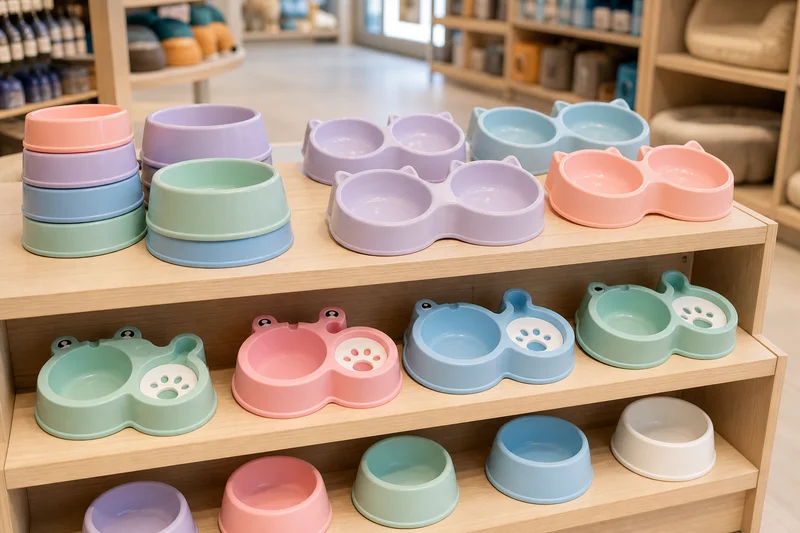
The current product family includes molded plastic bowl options for cats and small dogs. The available range covers single bowls, double bowls, cat-head double bowls, frog-style double bowls, cat-paw bowls, and a frog-style water storage bowl.
Key product information includes:
- Product reference: XPS-ZS-BOWL-001 family
- Category: Feeding & Watering
- Species: cats and small dogs
- Material: molded plastic bowl body; stainless-steel inserts may apply to selected options
- Color directions: blue, pink, purple, green, white, and supplier color options
- Application: pet stores, wholesalers, retail chains, online sellers, and mixed pet supplies programs
The size range gives buyers several price and shelf options. Examples include small 17 x 6.5 cm single bowls, 23 x 12 x 4 cm small plastic pet bowls, 28 x 15 x 5.5 cm cat-head double bowls, 29 x 15 x 8 cm large plastic double bowls, 32 x 19 x 5 cm new frog-style double bowls, and 35 x 19 x 5 cm large frog-style double bowls.
How to build a focused bowl assortment
A strong feeding assortment does not need every bowl shape in the first order. A better starting point is to select a few roles and let each SKU serve a clear purpose.
| Assortment Role | Useful Bowl Type | Buying Purpose |
|---|---|---|
| Entry price item | Small single plastic bowl | Low-cost add-on SKU for cats and small dogs. |
| Daily-use core | Large or medium double bowl | Food and water setup for basic feeding sections. |
| Visual retail item | Cat-head or cat-paw bowl | More attractive shelf display and online listing photos. |
| Character option | Frog-style double bowl | Colorful product for impulse buying and themed assortments. |
| Function variation | Water storage bowl | Useful for buyers who want a feeding and watering variation in the same category. |
This structure keeps the product range clear. Instead of creating many nearly identical listings, buyers can use one product-family page, select model numbers, and quote the preferred color and size mix.
Carton planning matters for bowl products
Plastic bowls are usually lightweight, but carton quantity and carton volume still matter. A low unit price does not automatically mean a low landed cost if the packed volume is high or if the SKU mix creates too many partial cartons.
Examples from this product family include:
- large plastic double bowl: 29 x 15 x 8 cm, 200 pcs/carton, 60 x 50 x 50 cm carton reference;
- medium plastic double bowl: 24 x 13 x 6 cm, 260 pcs/carton, 60 x 50 x 50 cm carton reference;
- double-handle cat bowl: 31.5 x 17.5 x 7 cm, 150 pcs/carton, 54 x 34 x 56 cm carton reference;
- cat-head plastic double bowl: 28 x 15 x 5.5 cm, 200 pcs/carton, 64 x 59 x 38 cm carton reference;
- frog-style water storage bowl: 29 x 19 x 5 cm, 72 pcs/carton, 58 x 57 x 55 cm carton reference.
For mixed orders, carton planning should be checked together with toys, carriers, beds, grooming products, and other daily-use items. This prevents the order from becoming visually rich but inefficient to ship. The same planning logic applies in a mixed container pet supplies SKU plan.
Packaging and QC checks before confirming an order
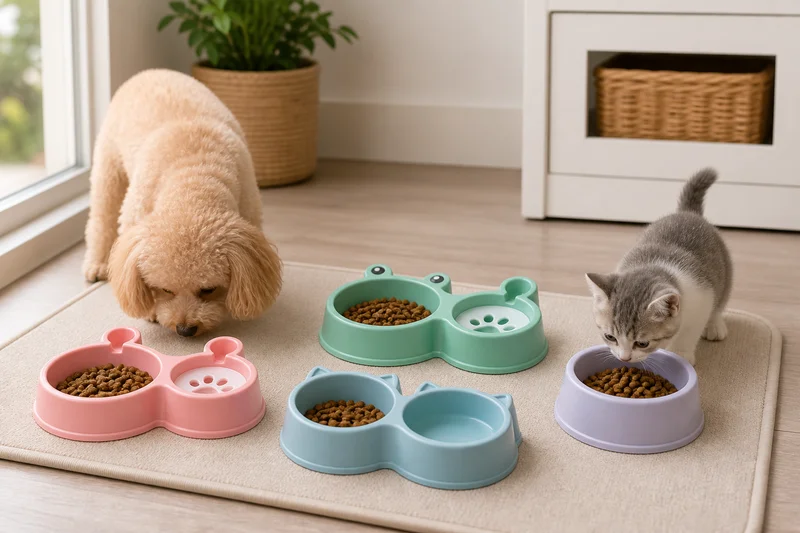
Plastic bowls look simple, but buyers should still confirm practical details before mass production. Small issues such as unstable stacking, rough edges, weak color consistency, or unclear carton marks can affect warehouse handling and retail presentation.
Before confirming production, check:
- Finished size: confirm the actual product size, bowl depth, and usable feeding space, not only the model name.
- Plastic finish: inspect surface smoothness, edge finish, color consistency, and molding marks.
- Stability: check whether the bowl sits flat and whether double bowls remain stable during normal use.
- Stacking and packing: confirm how many pieces stack together and whether the carton protects rims and decorative shapes.
- Color mix: clarify color ratio before production so the delivered assortment matches the retail plan.
- Retail details: confirm label, barcode, insert card, carton mark, and any cleaning or use instructions required by the buyer.
If the bowls are part of a retail-ready project, use a pet supplies packaging checklist before printing labels or carton marks. Even low-cost SKUs need clean packaging information when they enter retail chains or online warehouses.
How pet stores can sell bowls with related products
Bowls work best when they are not treated as isolated accessories. They can be displayed with food mats, pet food, treat products, cleaning wipes, travel carriers, cat beds, and small dog products. For example, a new-pet starter section may include bowls, a small bed, a carrier, grooming combs, toys, and hygiene products.
On this site, feeding products can be planned together with melamine pet bowls for a higher retail presentation, plastic pet carriers for travel and starter kits, and plastic round and oval cat beds for cat-focused assortments.
For stores that reorder regularly, feeding products should be reviewed by sell-through, color preference, carton efficiency, and customer feedback. The reorder method is similar to pet store reorder planning for mixed pet supplies: keep the winning models, reduce slow duplicates, and update color mix based on real sales.
Source plastic pet bowls with Xinji Pet Supplies
Xinji Pet Supplies helps overseas buyers source multi-category pet supplies from China, including feeding bowls, water bowls, beds, carriers, toys, apparel, grooming products, hygiene products, treats, and seasonal assortments. For plastic pet bowls, we can help compare model options, color mix, carton packing, sample route, and retail packaging requirements.
If you are preparing a feeding and watering category for pet stores, e-commerce listings, wholesale distribution, or mixed pet supplies orders, send your target market, preferred model numbers, estimated quantity, color requirements, packaging plan, and any label or carton mark needs. We can prepare a practical quotation direction and product recommendation list.